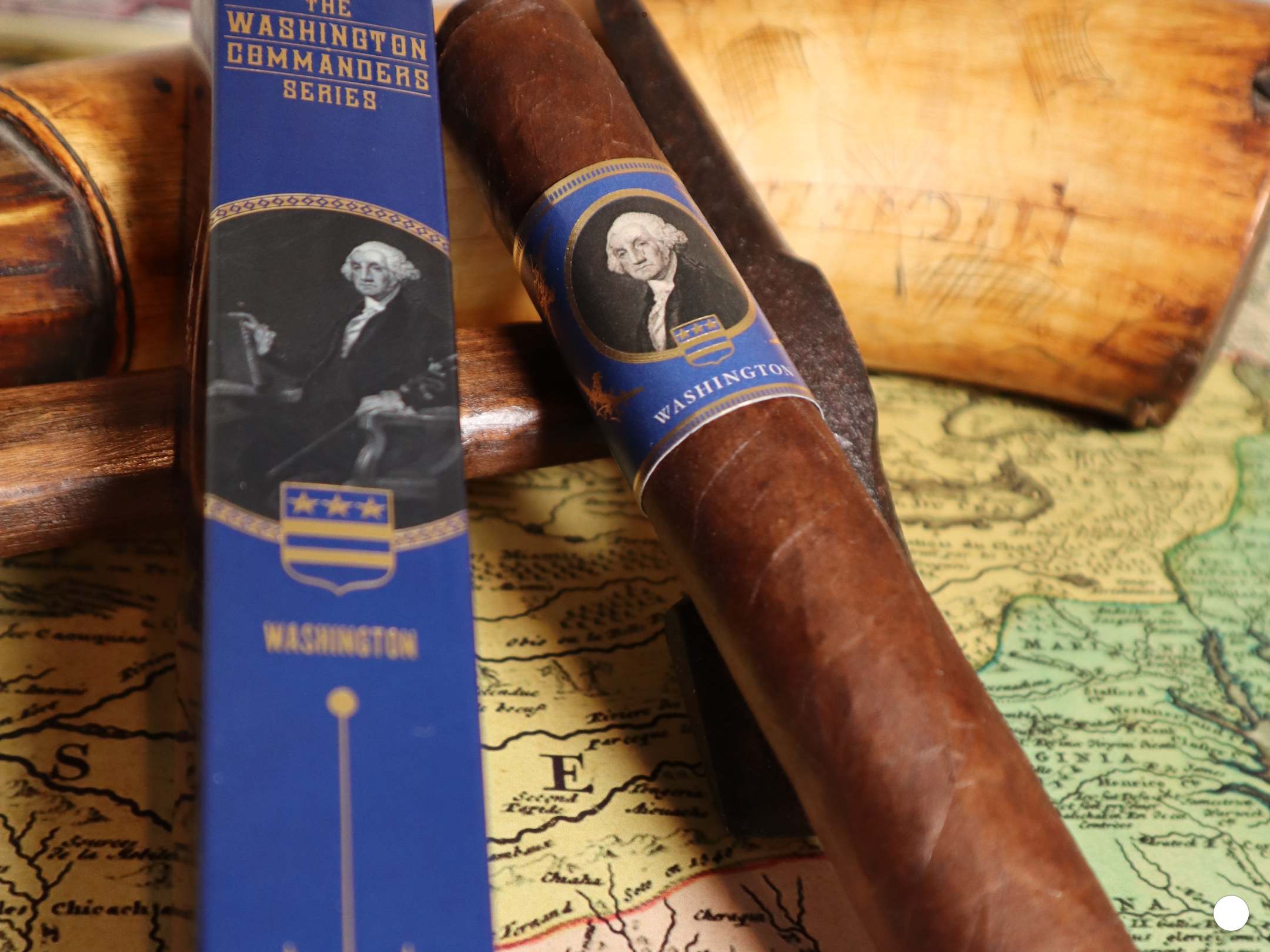
James Monroe was a fascinating figure in American history. One story in particular stands out and demonstrates perfectly the fragility and happenstance that comprises the better part of our lives.
Below is the story we like to tell while enjoying a James Monroe with friends…
The unrelenting barking of the dogs was so loud that the noise somehow penetrated the swirling veil of the cold, howling wind. A brutal early morning nor’easter had timed its fury perfectly with the American’s pending attack, making the roads to their destination all the more impassible. The dogs’ irascible owner augmented the winter torrent with ill temper of his own, as he shouted and threatened the young lieutenant standing ankle-deep in his snow-packed yard. “He was violent and determined in his manner, and very profane,” recounted the lieutenant. The man suspected “we were from the British Army, and ordered us off.”
Although just eighteen years old and an erstwhile sophomore at The College of William and Mary, the company commander was a veteran soldier, having fought bravely in the Battles of Harlem Heights and White Plains. He was not intimidated, ordering the unruly man back into his house while accompanying his stern command with the threat of otherwise taking him prisoner. For another moment or so the two men continued to wrangle when suddenly the angry man realized that his bombastic diatribe was being aimed at Americans’ rather than the British. After collecting himself, his entire disposition turned instantly to one of goodwill. He then offered to join the American’s in their fight. “I’m a doctor,” he explained with a tone opposite to the tirade of before, “and I may be of help to some poor fellow.” In a few hours these simple words would morph beautifully into heroic deed.
The American company that the repentant doctor had newly joined was part of General Nathaniel Greene’s Division on its way to Trenton. Captain William Washington, who was a distant cousin of the Commander-in-Chief, led the company. The surgeon-volunteer readied himself for the march and fell in line next to the very man, just moments before, he had berated. The doctor surely must have thought, for a moment at least, that he should have stayed in his house next to the warm glow of his fireplace.
Several of the men would later remember that the weather was much worse on the march than it had been on the crossing of the ice-choked river hours before. The wind, snow and ice were blowing about so wildly as to make it difficult to see, even a few feet ahead.
Despite the weather, and indeed because of it, they quickly moved on. A soldier in misery always wants to get where he’s going, reasoning however much in error, that where he is going must be better than where he is.
Approaching from the west and reaching the predetermined point where the army was to split north and south in an attempt to envelope the town of Trenton, the brave lieutenant’s division broke northward with General Washington at its head. As yet undetected – or so he thought, Washington hoped that the element of surprise was still in his arsenal of weapons. Surprise, after all, was the most important aspect of his daring plan.
Washington was near mad as he spotted a contingent of soldiers up ahead. Many of his subordinates would say that they had never seen him so angry. The one indispensable part of the attack was now compromised, he thought, as the American division came upon a band of soldiers whom they perceived were the enemy. It was quickly determined however that they were a group of roughly fifty rogue American’s who had spirited across the Delaware River the previous night. They had come across to exact revenge on the enemy for having earlier killed one of their own. The American raiding party attacked one of the several Hessian outposts located a mile or so outside the town, killing four of the out guard’s and wounding eleven more. They then disappeared into the darkness but did not return across the river. As such, they were available to the General-in-Chief. Washington, not knowing of the unauthorized raid until now, summoned the columns commander, Adam Stephen. “You, Sir!” he shouted in an uncharacteristic rage. “You, Sir, may have ruined all my plans by having put them on guard.”
Contrary to the popular lore of reveling soldiers lost in a bacchanalian stupor, a falsehood that has been propagated now for two centuries, the Hessians were not taken entirely by surprise nor were they drunk. Boston fifer John Greenwood, who after the fighting, being charged with guarding the Hessian prisoners would later write in his memoirs, “I am willing to go upon oath, that I did not see even one solitary drunken soldier belonging to the enemy – and you will find, as I shall show, that I had an opportunity to be as good a judge as any person there.” The Hessians were professional, well drilled, conscripted soldiers. They were so named because a great percentage of them came from the Hesse region of Germany. Colonel Johann Rall, the gristly, veteran commander of the mostly Hessian mercenaries who were garrisoned at Trenton, had earlier received credible intelligence from numerous sources that the Americans were planning a surprise attack. The professional and capable commander had taken prudent and thorough steps to prevent it.
Colonel Rall had for months employed a concentric ring of outposts around the town, with sentries making constant rounds in the gaps in between. After Adam Stephen and his Virginians staged their deadly raid on one of the outposts, Rall doubled the guard at the posts.
Ironically, Adam Stephen’s pay back raid may well have aided Washington in his desire for surprise. Even though Colonel Rall had increased the patrols, he might well have believed that the raid by Stephen was the surprise attack, which had been rumored for days. He lay in his nightdress, asleep as the Americans drew near.
Washington was famous for his self-control and, true to form; he quickly marshaled all his faculties. He and his army were two miles from Trenton. The time was 7:30 a.m. and the sun had risen 10 minutes earlier. It was still dark however as the nor’easter which had been present at the crossing was still raging and with ever greater fury. Somehow, General Washington, it seems, was always able to conscript the weather into his army. Though three hours behind schedule, thick clouds blanketed the early morning sun.
Sleet, snow and heavy rain fell all at once. The soldiers were having trouble keeping their flints and powder dry so despite the intense cold, they used their coats and blankets to cover their weapons rather than themselves.
Greene’s Division with Washington at the head approached from the north while Sullivan’s Division traveled down the River Road came toward the town from the West. Washington halted his men behind the cover of a forest about 800 yards from the Hessian outpost on Pennington Road, which stood about a mile from the town center.
Washington formed his men into three columns with himself in the lead and began their “long trot” across the fields.
Colonel Rall’s having ordered the guard doubled at the outposts, made the inside of small buildings somewhat intolerable for any extended period of time. So despite the blistering storm, Hessian officer, Lt. Wiederholdt may of stepped out of the warm outpost looking for air. Whatever his reason, his first vision after closing the door behind him, was of a large group of men approaching from the northwest. Initially, he thought them to be his own men. As the force grew in size, he realized it was too large a group to be his own Hessian sentries. His thoughts were confirmed when, an American, seeing the German lieutenant, fired the first shot. General Sullivan’s artillery began bombarding the town in perfect timing with the American advance. Washington had gotten his wish – the Hessians were surprised.
Der Feind! Der Feind! The Enemy! The Enemy!
Washington’s soldiers unleashed a fury of musket fire on the stammering Germans. Lt. Wiederholdt and his Hessians “fought with them until we were almost surrounded by several battalions. I therefore retreated under constant fire.”
Washington quickly ordered his left column to secure the Princeton Road. The outpost on the Princeton Road fell in the same manner as the Wiederholdt’s and retreated in the like-manner with him. The Two Hessian groups drew back further and took position at the North end of town at the head of King and Queen Streets but the American’s soon overwhelmed them. Washington, out in front, admired the Hessians skill in retreating, remarking after the battle that the out guard’s “behaved very well, keeping up a constant retreating fire from behind houses.”
As the Hessians fled back into the town, American artillery rained on them from the Pennsylvania side of the river. The nor’easter all-the-while raged more violently than ever.
Hessian Lieutenant Jakob Piel raced to informed Colonel Rall, still dressed in his nightshirt. Der Fiend! Heraus! The Enemy! Turn Out! Piel shouted. Rall shouted back, “Was ist los?” What’s the matter? The Lieutenant answered back, “Do you not hear the firing?” Colonel Rall now awakened to the need for alarm, hurriedly dressed and mounted his horse.
By now Lieutenant Wiederholdt and his men had retreated to the center of town where Colonel Rall was assembling his regiment. Rall asked him for a report. The next few moments would decide the fate of America in innumerable ways. Lt. Wiederholdt erred when he told the colonel that Americans had surrounded them on three sides. Perhaps it was the raging storm or the confusion of battle, but whatever the reason Lt. Wiederholdt was mistaken. Even though the Americans would eventually envelope them from three sides, a t that point they had not, managing thus far to only occupy two.
The decision Rall made next would seal his fate and that of the fledgling nation.
Rall and his Hessians could retreat over the Assunpink Bridge to the south, which offered high defensive ground and was, at that moment, still open to retreat. Once across the bridge, he could await massive and readily available reinforcement, which could be used to defeat, if not destroy, Washington’s army. Instead, the pugnacious German chose to fight. He no doubt thought his reasons sound. He had seen the Americans fight at New York and had little respect for the ragtag army, especially against his professional Germans. He knew them to be poorly fed and ill equipped. Many of them were barely clothed and even shoeless in the raging storm.
But Washington held the high ground at the head of King and Queen Streets, which paralleled one another and were more or less perpendicular to the point at which the Delaware River and the Assunpink creek met to the South. From this elevated vantage Washington could see every part of the battle. Sullivan’s leading his column, which earlier had split to the south, positioned his troops at the foot of King and Queen. Rall’s Hessian’s stood in the middle of the two.
Rall drew up his Hessians and bringing forth the regimental colors, counterattacked with his accustomed zeal. The American’s meanwhile had occupied the houses in the town. This shielded their flint and powder from the violent wet weather, allowing them to fire at will. They were blasting at the Hessians from every direction. The Hessian’s, exposed to merciless fire and unable to fire themselves, due to the heavy downpour, were forced to retreat eastward through the churchyard and then into an apple orchard outside of town. The American’s had capture Rall’s regimental cannons and were now training it back on the German’s. The loss of those cannons was an affront to the honor of his regiment. As his men were also keenly aware of the disgrace in losing them, they did not bristle at their colonel’s command to recapture them. “Alle was meine Grenatir seyn, vor werds! All who are my grenadier’s, forward!
The soldiers dutifully charged toward the two big guns and quickly recaptured them. But now, the American’s were at risk of losing their own honor, having captured the two cannons only to have them taken back. American officer Colonel Knox, on horseback, rode up to Sergeant White who moments ago had fired his cannon so audaciously that its undercarriage had broken and fallen away, looked to the Hessian artillery and said “My brave lads, go up and take those pieces sword in hand. There is a party going and you must join them.” Captain William Washington and his young lieutenant led the “party going”. The same lieutenant who just hours earlier had been arguing with the owner of the barking dogs, Dr. John Riker.
The blinding storm and the violent battle was still swirling around them when the captain and lieutenant burst toward the cannon. “Captain Washington rushed forward, attacked and put the troops around the cannon to flight and took possession of them.” During the assault, Captain William Washington was badly wounded, first in one hand, and then the other. He fell. The young lieutenant took the lead “at the head of the corps” and fought his way forward. Suddenly a musket ball ripped into his chest and exited through his shoulder, severing a main artery. He was bleeding profusely and was carried from the field. A huge volume of blood pooled around him. He was bleeding to death when Dr. Riker who instantly recognized the mortal danger the young man was in spotted him. He opened the wound and expertly clamped the hemorrhaging artery, saving the lieutenant’s life.
At that moment, no one could of known that the man whose life was saved would go on to become President of the newly created United States. But one thing is known for sure – that had the lieutenant not quarreled with an ornery old doctor on the way to the Battle of Trenton, he would not have lived to see the American nation born.
The “poor fellow” that Dr. John Riker “helped”was…
James Monroe
God Bless You All.