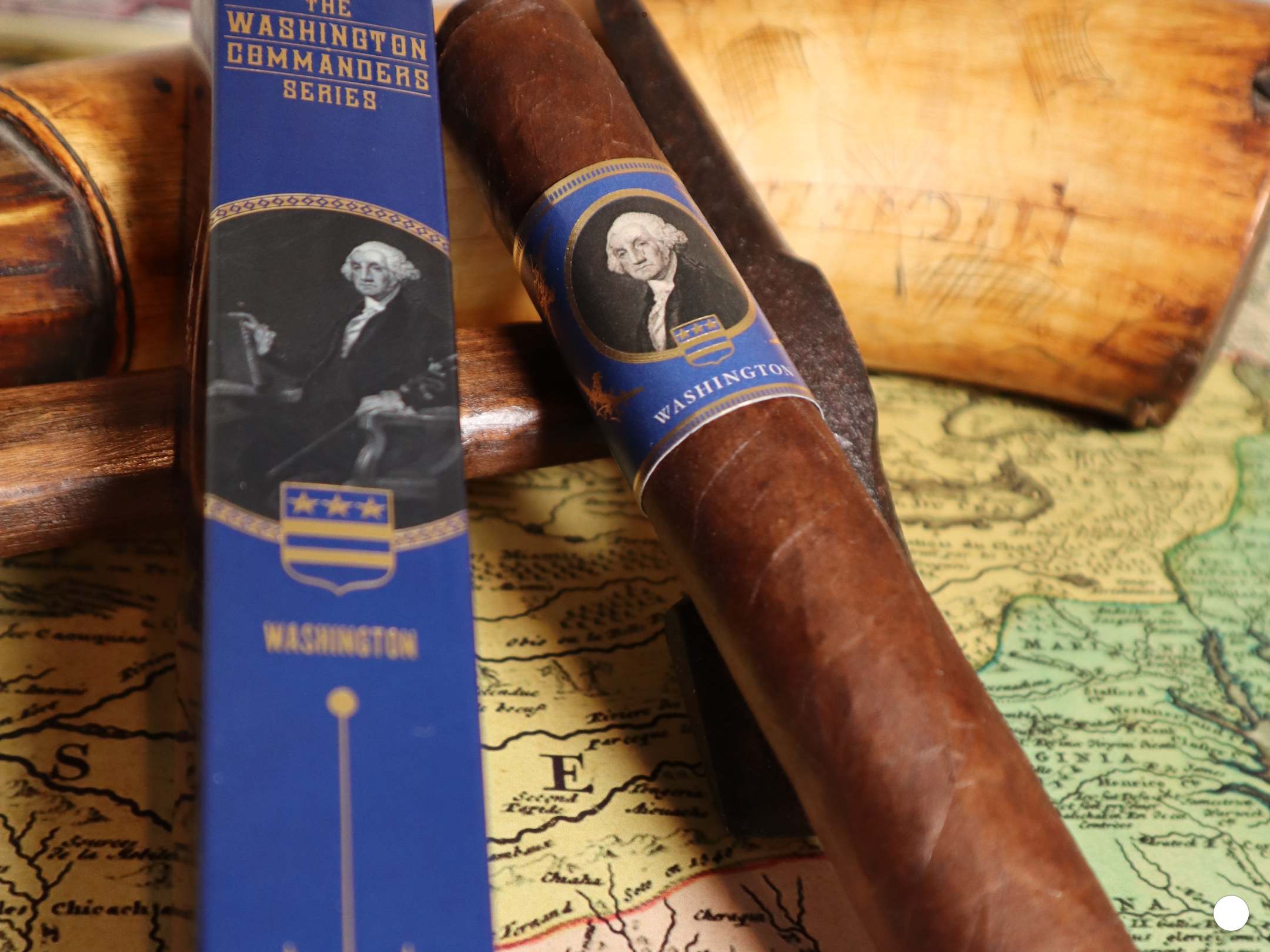
A Year With George Washington
January 18th, 1784 – Washington, having returned to his beloved Mount Vernon just after the Revolutionary War, writes to Virginia Governor Benjamin Harrison regarding the future of the now independent nation.
The bloody War of Independence was over, and the formal ratification by the Congress of the Confederation had concluded just four days before, when Washington sat down to pen a return letter to Governor Benjamin Harrison of Virginia.
Benjamin Harrison, six years older than Washington, had been an early and stouthearted champion of the cause of liberty. He had even once turned down a bribe offered in exchange for his renouncing his loyalty to the American cause.
John Adams, upon first meeting him, found him disagreeable, writing that Harrison was just “another Sir John Falstaff,” the buffoonish Shakespearean character whom the great bard used as a comic device in several of his famous plays.
But Adams eventually warmed to Harrison’s sense of humor, admitting that “Harrison’s contributions and many pleasantries steadied rough sessions.” Benjamin Rush concurred with Adams in his unfavorable opinion of him. Still, he could not help but appreciate his impeccable comedic timing as he lightened the mood, despite ominous thoughts filling the room as the signers each penned their signatures on the Declaration of Independence, known to them as their death warrant.
Harrison V, as he was called (he came from a long line of so-named fathers and sons), was, like Washington, unusually tall for the era and had a keen mind. But that is where the similarities ended. He was also rotund and gregarious, whereas Washington was athletic and reserved. The two had clashed early in the war when Washington wanted the Marquis de Lafayette to be paid for his service during the war, and Harrison thought the Frenchman ought to provide his services for free, as the Marquis was one of the richest men in all of France.
Harrison was rich himself. He was the eldest son and thus entitled to the bulk of his father’s estate upon his tragic death, who died unexpectedly. During a violent storm, his father, holding his young daughter, moved to shut a window. Before he was able to close it, a lightning bolt struck the two of them. They both were killed instantly. Benjamin was just nineteen at the time and inherited several profitable plantations and an enormous amount of land. Like many of his fellow wealthy Virginians, he felt a duty to immerse himself in the prevailing issues of the day, namely the king and parliament’s oppressive governing of the colonies. Harrison served in many public capacities leading up to the conflict with Great Britain.
Harrison would need his good humor as he suffered greatly during the war, losing a significant amount of his wealth. Turncoat Benedict Arnold, after defecting to the British side, raided Virginia in 1781 and sought to send a harsh message to the prominent Virginians, thinking they would yield and capitulate.
After burning Richmond to the ground, Arnold, in his retreat, came upon Harrison’s beautiful Berkeley Plantation, removed all the personal family possessions to the front courtyard, and set them on fire. The only reason Arnold didn’t burn the house itself down was that he believed Great Britain, with his help no doubt, would win the war, and thus thought Berkeley would make the perfect home for him after the war. Fortunately, Arnold was mistaken on both counts.
Washington and Harrison’s wartime disagreement did not deter them from conversing about the state of the nation after the war. He knew that the United States, though independent, was still untried and in need of strong governance. He therefore sought the advice, opinion, and support of the powerful people around him.
Washington’s letter (below) is both candid and cordial, and it strikes a cautionary tone about the need to temper the unwieldy nature of the various states, each vying for its own interests above those of the whole. He makes the point that our elected representatives deserve our support, but that we should take care to elect only those of good character and those inclined to carry out the will of the people while eschewing their own interests.
As is true of most of George Washington’s missives, his letter to Harrison (see below) is brimming with foreshadowing wisdom and well worth reading two and a half centuries later.
Mount Vernon 18th Jany 1784
My Dear Sir,
I have just had the pleasure to receive your letter of the 8th—for the friendly & affectionate terms in which you have welcomed my return to this Country & to private life; & for the favourable light in which you are pleased to consider, & express your sense of my past services, you have my warmest & most grateful acknowledgments.
That the prospect before us is, as you justly observe, fair, none can deny; but what use we shall make of it, is exceedingly problematical; not but that I believe, all things will come right at last; but like a young heir, come a little prematurely to a large inheritance, we shall wanton and run riot until we have brought our reputation to the brink of ruin, & then like him shall have to labor with the current of opinion when compelled perhaps, to do what prudence & common policy pointed out as plain as any problem in Euclid, in the first instance.
The disinclination of the individual States to yield competent powers to Congress for the Foederal Government—their unreasonable jealousy of that body & of one another—& the disposition which seems to pervade each, of being all-wise & all-powerful within itself, will, if there is not a change in the system, be our downfal as a Nation. This is as clear to me as the A, B.C.; & I think we have opposed Great Britain, & have arrived at the present state of peace & independency, to very little purpose, if we cannot conquer our own prejudices. The powers of Europe begin to see this, & our newly acquired friends the British, are already & professedly acting upon this ground; & wisely too, if we are determined to persevere in our folly. They know that individual opposition to their measures is futile, &boast that we are not sufficiently united as a Nation to give a general one! Is not the indignity alone, of this declaration, while we are in the very act of peace-making & conciliation, sufficient to stimulate us to vest more extensive & adequate powers in the sovereign of these United States? For my own part, altho’ I am returned to, & am now mingled with the class of private citizens, & like them must suffer all the evils of a Tyranny, or of too great an extension of fœderal powers; I have no fears arising from this source; in my mind, but I have many, & powerful ones indeed which predict the worst consequences from a half starved, limping Government, that appears to be always moving upon crutches, & tottering at every step. Men, chosen as the Delegates in Congress are, cannot officially be dangerous—they depend upon the breath—nay, they are so much the creatures of the people, under the present Constitution, that they can have no views (which could possibly be carried into execution), nor any interests, distinct from those of their constituents. My political creed therefore is, to be wise in the choice of Delegates—support them like Gentlemen while they are our representatives—give them competent powers for all federal purposes—support them in the due exercise thereof—& lastly, to compel them to close attendance in Congress during their delegation. These things under the present mode for, & termination of elections, aided by annual instead of constant Sessions, would, or I am exceedingly mistaken, make us one of the most wealthy, happy, respectable & powerful Nations, that ever inhabited the terrestrial Globe—without them, we shall in my opinion soon be every thing which is the direct reverse of them.
I shall look for you, in the first part of next month, with such other friends as may incline to accompany you, with great pleasure, being with best respects to Mrs Harrison, in which Mrs Washington joins me, Dear Sir, Your Most Obedt & affecte hble servant
G: Washington